
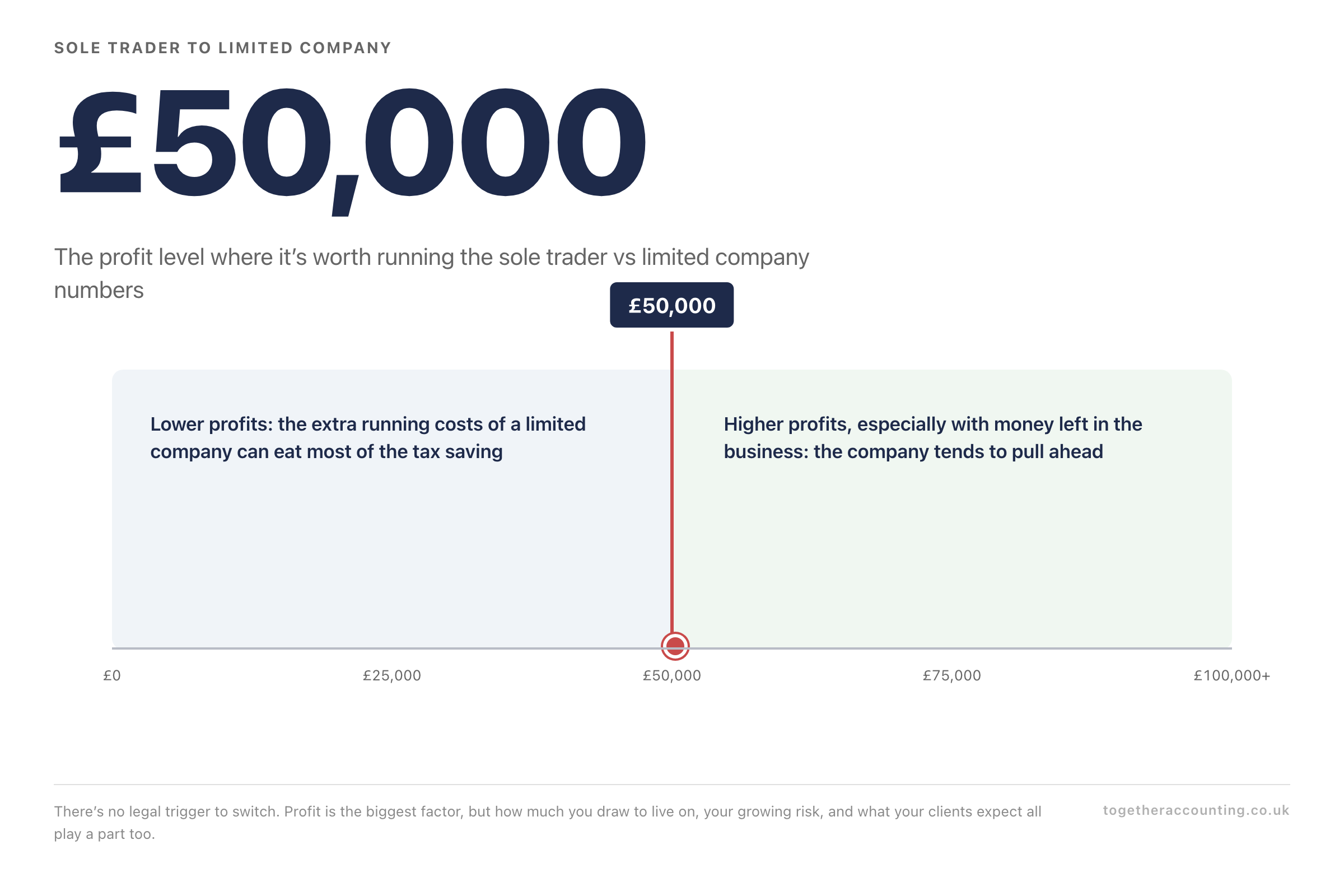
“Should I go limited yet?” is one of the questions we hear most from sole traders, usually around the time their tax bill starts to feel personal. For a lot of people, profits around £50,000 a year are the point to start doing the sums. If you draw out every pound, a company rarely saves tax at that level, so the real gain usually comes from profit you can leave in the business.
The rules have moved since most of the advice online was written. Dividends cost more to take and so does a director’s salary. On top of that, Companies House now checks the identity of every director before a company can exist. If you read something a couple of years ago and took it as gospel, it’s time to look again.
The headline numbers right now
|
19% / 25% |
10.75% / 35.75% |
|
15% |
£100 |
Is it worth going from sole trader to limited company?
It can be. The answer turns on two things more than any other: how much profit you make, and how much of it you actually need to live on. Risk comes into it too.
Here’s how the tax side works. As a sole trader you pay Income Tax and Class 4 National Insurance on all your profits, spent or not, because that profit counts as your personal income. A limited company is a separate legal entity. It pays Corporation Tax on its profits, and you then pay yourself through a mix of salary and dividends, taking out only what you need. Money left in the company is taxed at the Corporation Tax rate and nothing more until you draw it.
That flexibility is where the savings come from. The gap between the two structures is narrower than it used to be, though, because dividends are now taxed two percentage points more than they were a few years ago. Anyone who worked out their saving back then and hasn’t rerun it is probably overestimating it.
Then there’s limited liability. As a sole trader, you and the business are the same thing in law, so if it fails owing money, your savings and even your home are on the line. A company’s debts belong to the company. Your exposure is usually capped at anything you still owe on your shares, plus any personal guarantee you’ve signed (banks and landlords often ask for one, so read before you sign). For anyone taking on staff or big contracts, that protection alone can justify the switch.
Who pays less tax, sole trader or limited company?
Here’s how the two structures compare on current rates.
| Category | Sole trader | Limited company |
|---|---|---|
| Tax on profits | Income Tax at 20%, 40% and 45% on everything above your £12,570 Personal Allowance | Corporation Tax at 19% up to £50,000, 25% above £250,000, Marginal Relief in between |
| National Insurance | Class 4 at 6% between £12,570 and £50,270, then 2% above | Employer NI at 15% on salaries above £5,000, with Employment Allowance of up to £10,500 for eligible companies |
| Drawing money out | No extra tax, all profit is already taxed | Dividends taxed at 10.75%, 35.75% or 39.35%, after a £500 allowance |
| VAT | Register once turnover passes £90,000 | Same £90,000 threshold |
| Companies House costs | None | £100 to incorporate online, £50 a year for the confirmation statement |
| Personal liability | Unlimited | Usually limited to what you’ve put into the company |
There’s no single winner. At lower profits, the extra running costs of limited companies can eat most of the tax saving. As profits climb, and especially once you’re leaving money in the business, the company tends to pull ahead.
How the Corporation Tax rate changes as profits rise
| Small profits rate Up to £50,000 |
|
||
| Marginal Relief £50,000 – £250,000 |
|
||
| Main rate Above £250,000 |
|
Marginal Relief tapers the rate between the two thresholds, so the effective rate climbs gradually from 19% to 25% rather than jumping straight to it. Source: gov.uk Corporation Tax rates and allowances.
Current rates on profits: sole trader vs limited company
Sole trader
| Income Tax (basic rate) |
|
||
| Income Tax (higher rate) |
|
||
| Class 4 NI (main rate) |
|
||
| Class 4 NI (upper rate) |
|
Limited company
| Corporation Tax (small profits rate) |
|
||
| Corporation Tax (main rate) |
|
||
| Dividend tax (ordinary rate) |
|
||
| Dividend tax (upper rate) |
|
These are the current rates on profits, not a modelled saving between structures. Class 4 NI applies between £12,570 and £50,270 (main rate) and above that (upper rate). Corporation Tax Marginal Relief applies between £50,000 and £250,000 profit. Source: gov.uk Income Tax rates and Personal Allowances, gov.uk Corporation Tax rates and allowances, gov.uk dividend tax rates, gov.uk self-employed National Insurance rates.
Plenty of older articles still get one thing wrong. Sole traders with profits above the small profits threshold (currently £7,105) no longer pay Class 2 National Insurance. HMRC treats it as paid automatically, so your State Pension record still builds. You only pay Class 4.
So what does that look like in pounds? We’ve modelled one director in England with no other income who takes every pound of profit out of the business. On the company side that means a £12,570 salary (set at the Personal Allowance), £1,135.50 of employer NI on it because a sole director with no other staff can’t claim Employment Allowance, Corporation Tax at 19%, and the rest paid out as dividends at current rates.
| Profit | Sole trader: Income Tax and Class 4 NI | Limited company: employer NI, Corporation Tax and dividend tax | Take-home as a sole trader | Take-home through a company |
|---|---|---|---|---|
| £50,000 | £9,732 | £11,138 | £40,268 | £38,862 |
| £60,000 | £13,889 | £13,909 | £46,111 | £46,091 |
Draw it all out and the company costs you about £1,400 more at £50,000, while at £60,000 the two land within £20 of each other. These figures leave out company running costs such as accountancy and the annual Companies House confirmation statement, which widen the gap further. The saving shows up when you leave profit in the company, taxed at 19% with no dividend tax until you draw it. Leave £10,000 of a £60,000 profit in the company, for example, and this year’s tax bill comes out about £850 lower than a sole trader’s, though that dividend tax is deferred until you draw the money, not avoided.
At what point should a sole trader become a limited company?
There’s no legal trigger. But four signals usually mean it’s time to run the numbers properly.
Profits around £50,000 or more. This is the long-standing rule of thumb, and it still works as a prompt to look. On current rates, though, a company doesn’t save tax at £50,000 or £60,000 if you take every pound out. The gain comes from profit you leave in the business.
You don’t need all the profit to live on. If you’d happily leave £10,000 or £20,000 a year in the business, the limited company structure lets that money sit taxed at Corporation Tax rates instead of your top Income Tax rate.
Your risk is growing. Staff, premises, bigger contracts or borrowing all raise what you could lose personally.
Clients expect it. Some larger clients and agencies prefer, or insist on, working with limited companies.
If only the first one applies, it’s a closer call than people think. Our view is simple. At around £50,000, if you spend almost everything you earn and your risk is low, don’t incorporate for the tax alone. The paperwork is real and the saving may not be.
Making Tax Digital for Income Tax (MTD) nudges some people the other way: sole traders with qualifying income (turnover, before expenses) over £50,000 currently have to keep digital records and send HMRC quarterly updates, and that threshold drops to £30,000 from 6 April 2027 and £20,000 from 6 April 2028. Limited companies aren’t part of it, and dividends from your own company don’t count towards the threshold.
Worked Example: Take a freelance graphic designer making £48,000 profit as a sole trader and spending most of it. Under the old rule of thumb, she’s nearly there. Now add the higher dividend rates, payroll for a director’s salary and the Companies House fees. There’s a catch on the salary, too. As the company’s only director and only employee, she can’t claim Employment Allowance, so any salary above £5,000 carries 15% employer NI. The saving on paper shrinks. The practical answer: model both structures on current rates before registering anything.
Can I change from a sole trader to a ltd company?
Yes, and you don’t close the business in the usual sense. You set up a new company, then move the trade, and usually the assets, into it. Here’s the checklist we’d work through with you to form a limited company.
- Choose a company name and check it’s available on the Companies House register.
- Verify your identity. Every director now has to verify their identity with Companies House, through GOV.UK One Login or an Authorised Corporate Service Provider, and use the personal code on the application. Do this first, because a missing verification holds up everything else.
- Register the company online. It currently costs £100 and is usually done within 24 hours. You’ll set out the directors, shareholders and share structure at this stage.
- Register for Corporation Tax within three months of the company starting to trade.
- Tell HMRC you’ve stopped being self-employed and file a final Self Assessment tax return covering your income and business expenses up to the date you stopped.
- Open a separate business account in the company’s name. Company money isn’t your money any more.
- Sort out VAT. If you’re already VAT registered, you can transfer the registration and keep your number using form VAT68, or register the company fresh. If you aren’t, register once turnover passes £90,000.
- Set up PAYE if you’re paying yourself or anyone else a salary.
- Transfer your assets such as equipment, vehicles, stock and goodwill. This can trigger Capital Gains Tax, though incorporation relief may defer it when you swap the whole business for shares. Get advice from your accountant or solicitor before you move anything valuable.
- Tell clients, suppliers and insurers, and update contracts and invoices.
- Diary your confirmation statement date. It comes round every year, and Companies House ties identity checks to it.
What are the tax implications of changing business structure?
Your tax life changes shape more than size. The company files its own accounts and Company Tax Return, and has to pay Corporation Tax and run payroll for any salary. You still file a Self Assessment return, but now for the dividends you take.
Most owner-directors take a mix of salary and dividends. The salary keeps your National Insurance record ticking over and is a deductible cost for the company. Dividends come out of taxed profits but avoid National Insurance altogether. Getting that mix right matters more now than it did, because employer National Insurance currently starts at £5,000 a year of salary rather than the old £9,100, and dividend rates have gone up.
Employer National Insurance: the salary threshold has fallen
Previous threshold
£9,100
Salary a company could pay before employer NI applied
Current threshold
£5,000
Salary before employer NI applies now, so more of a director’s salary is taxed at 15%
A single-director, single-employee company cannot claim the Employment Allowance that offsets this for other small companies. Source: gov.uk Rates and thresholds for employers.
Employment Allowance helps many small limited companies by knocking up to £10,500 off their employer NI bill. A company whose only employee is a single director can’t claim it, though. So if that’s you, don’t assume your salary costs nothing in NI.
IR35 if you’re a contractor
Contractors face an extra question. IR35 asks whether you’d be your client’s employee if your company weren’t in the middle. Who controls how you work matters, and so does whether you could send a substitute. Financial risk counts as well. If a contract falls inside IR35, you pay tax much like an employee and most of the company’s benefit disappears. Check your main contracts against HMRC’s off-payroll working guidance before incorporating for tax reasons alone.
What to do next
Get your last two years’ figures together and work out how much you actually draw to live on. Then ask for a side-by-side on current rates. If the saving is real, start identity verification for every director first, and time the switch for a natural break such as the start of a tax year.
FAQ
Is it worth going from sole trader to limited company?
For some, yes, but mainly if you can leave part of the profit in the company. Draw it all out at £50,000 to £60,000 and a company currently costs about the same or more in tax.
Can I change from a sole trader to a ltd company?
Yes. You register a new limited company with Companies House, verify the identity of every director, register it for Corporation Tax, tell HMRC you’ve stopped being self-employed, and transfer the trade and assets across.
At what point should a sole trader become a limited company?
There’s no legal threshold. Profits around £50,000, money you’d leave in the business, rising risk or clients who prefer limited companies are the usual prompts.
Who pays less tax, sole trader or limited company?
At higher profits a limited company usually pays less, because Corporation Tax starts at 19% and you control when you take dividends. At lower profits the gap is small.
How long does it take to change from sole trader to limited company?
Companies House usually registers a company within 24 hours of an online application. The HMRC registrations, bank account, VAT and contracts take longer, so give yourself some runway.
If you’re weighing up a move from sole trader to limited company and want the numbers run properly for your business, get in touch. A short conversation now can save a messy first year.
This article provides general guidance based on current legislation. Tax and company law are complex and fact-specific. The information here should not be relied upon as advice for your particular circumstances. Please consult a qualified accountant or professional advisor for guidance tailored to your situation.
